POSTER WRITING

Poster Writing

Format, Guidelines, and Model Answers for Board Examinations

1. What Is a Poster?

A poster is a brief, visually striking piece of writing designed to communicate an important message at a single glance. It gives information through attractive pictures and carefully framed slogans on a particular topic or theme. It combines a small amount of carefully chosen text with a simple sketch or symbol, and is used to highlight a cause or to announce an event, spread awareness, appeal for support, or issue a warning. A poster must work instantly — a reader walking past should grasp its message within seconds.

2. Types of Posters

TypePurpose & Style
Event / Announcement PosterAnnounces a competition, workshop, exhibition, or fair; must clearly state date, time, and venue.
Awareness / Social Cause PosterRaises awareness on issues like water conservation, road safety, or pollution; relies on a strong slogan to move the reader.
Appeal PosterAppeals for help, donations, blood, or volunteers; emotionally persuasive tone with clear contact details.
Warning / Caution PosterCautions against a harmful practice (smoking, plastic use, drunk driving); direct, firm tone.

3. Standard Format

A poster is always enclosed in a neat rectangular border and laid out as shown below:

NAME OF ISSUING AUTHORITY

CATCHY TITLE / HEADING

Slogan / Tagline / Short Appeal

Simple Sketch
(relevant image)
• Key point 1
• Key point 2
• Key point 3

Date: DD/MM/YYYY
Time: __________
Venue: __________

Contact / Entry Free / Register Now (if required)

Issuing authority — the organisation or body releasing the poster (school, NGO, municipal body).

Title / heading — bold, large, and central; the first thing a reader notices.

Slogan / tagline — a short, memorable line, often using rhyme or repetition, that carries the emotional appeal.

Sketch — one simple, relevant drawing; never overcrowd the poster with multiple images.

Key points — presented as brief bullet points, not full sentences.

Event details — date, time, and venue, included wherever the poster refers to a specific event.

4. Word Limit & Marking Scheme

ComponentWhat examiners check
FormatBordered layout, issuing authority, title, slogan, sketch, and event details all present
ContentRelevant, on-theme information covering what, why, when, where
ExpressionGrammar, vocabulary, spelling, and neat, legible presentation

5. Key Writing Tips

  • Always draw a neat rectangular border using a ruler.
  • Name the issuing authority — a poster without a source looks incomplete.
  • Keep the title short, bold, and centred — no more than a few words.
  • Craft a slogan that uses rhyme, repetition, or a rhetorical question to make it memorable.
  • Present information in bullet points or short phrases, never long sentences.
  • Draw one simple, relevant sketch — a neat, small drawing scores better than an elaborate but messy one.
  • Include date, time, and venue for any event-based poster.
  • Add contact details or "entry free" only where the question calls for it.
  • Use varied, attractive lettering for the title, and leave clear spacing between sections.
  • Stay within the word limit if given, and proofread for grammar and spelling.

6. Common Mistakes to Avoid

MistakeCorrection
No border drawnAlways enclose the poster in a neat rectangular box
Writing in full sentences / paragraphsUse brief points and phrases, not connected prose
Overcrowding with multiple sketchesKeep to one simple, relevant image
Missing issuing authorityAlways state who is putting up the poster
No slogan or appealA poster without a catchy line loses persuasive impact
Exceeding the 50-word limitTrim ruthlessly — every word must earn its place

7. Model Answer — Sample Question

Question: Your school's Eco Club is organising a tree-plantation drive. Design a poster in not more than 50 words, inviting students to participate.

ECO CLUB, GREENFIELD PUBLIC SCHOOL

PLANT A TREE, GROW A FUTURE

"One seed today, one forest tomorrow"

🌱
Sapling sketch
• Join hands to green our campus
• Saplings provided by the club
• Open to all classes

Date: 5 June
Time: 8:00 a.m.
Venue: School Ground

Contact: Eco Club Coordinator

8. Further Practice Examples

8.1 Awareness Poster — Save Water

Question: Design a poster in not more than 50 words creating awareness about water conservation, on behalf of your Resident Welfare Association.

GREEN PARK RESIDENT WELFARE ASSOCIATION

SAVE WATER, SAVE LIFE

"Every drop counts, don't let it go to waste"

💧
Water drop sketch
• Fix leaking taps promptly
• Use mops, not hoses, to clean
• Harvest rainwater at home

For guidance, contact:
RWA Office, Block C

8.2 Appeal Poster — Blood Donation

Question: Your school is organising a blood donation camp. Design a poster in not more than 50 words appealing to staff and senior students to donate blood.

RED CROSS SOCIETY, SUNRISE SCHOOL CHAPTER

DONATE BLOOD, SAVE A LIFE

"A little of yours can mean everything to someone"

🩸
Blood-drop sketch
• Open to staff & students above 18
• Free health check-up included
• Certificates for all donors

Date: 20 August
Time: 9 a.m. – 1 p.m.
Venue: School Auditorium

Contact: School Health Office

Questions 
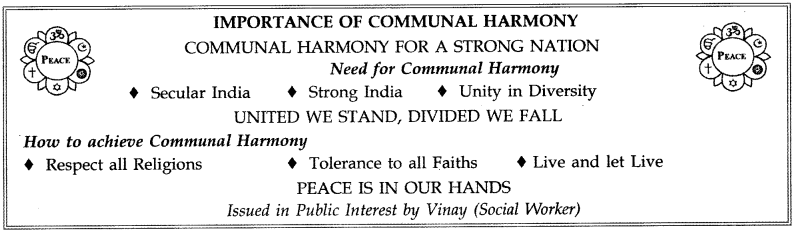
Question: 
    You were very upset about the reports on communal riots in various parts of the country. As a concerned social worker, design a poster in not more than 50 words, highlighting the importance of communal harmony. You are Vinay/Vineeta. (Comptt. All India 2014)

Answer:

Poster Writing Class 12 Format, Examples, Samples, Topics Q5


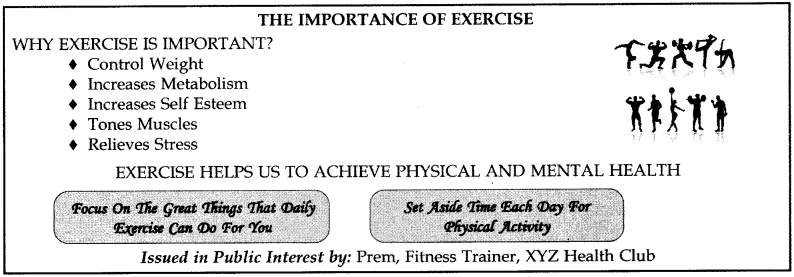
Question:
    You are a fitness trainer in a health club. Design a poster in not more than 50 words, to emphasize the importance of exercise in maintaining mental and physical fitness. You are Prem/Priya. (All India 2014)

Answer:
Poster Writing Class 12 Format, Examples, Samples, Topics Q7

Comments

Popular posts from this blog

How I Taught My Grandmother to Read: Story

 📖 Detailed Summary How I Taught My Grandmother to Read “How I Taught My Grandmother to Read” is a touching autobiographical story by Sudha Murty that highlights the importance of education and proves that learning has no age limit. The story revolves around the deep emotional bond between a young girl and her grandmother, Krishtakka , who is illiterate but determined to learn. The narrator, a twelve-year-old girl, lives with her grandparents in a small village in North Karnataka. Her grandmother , fondly called Avva , has never been to school due to the social conditions of her time, when girls’ education was not considered important. Despite this, she is wise, affectionate, and eager to learn new things. Every week, the family waits eagerly for the Kannada magazine Karmaveera , which contains a serialized novel titled Kashi Yatre written by Triveni. Since Avva cannot read, the young narrator reads the story aloud to her every Wednesday. This becomes a special ritual that strengt...

POEM:Bharat Our Land

 📖 “Bharat Our Land” – Detailed Study Note Poet: Subramania Bharati  1. Background & Context Subramania Bharati was a patriotic poet of the Indian freedom movement. His poems were written to: Inspire national pride Promote unity and self-respect Encourage social reform and awakening  “Bharat Our Land” reflects these ideas by presenting India as a great, sacred, and inspiring nation.  2. Central Idea  The poem celebrates India as: A land of natural beauty A center of ancient wisdom A nation of courageous people  The deeper message is: India is great not only because of its past, but because of its potential and spirit.  3. Detailed Explanation (Systematic)  A. Nature as a Symbol of National Greatness Natural elements like mountains and rivers are used symbolically: Mountains → strength and stability Rivers → purity and life  Important Accuracy Point: The poet is not making factual comparisons, but expressing emotional pride and admiratio...

Determiners

Determiners (Reference: Oxford Advanced Learner’s Grammar / Practical English Usage – Oxford) 1. What are Determiners? According to Oxford grammar, determiners are words placed before a noun to limit, specify, or clarify the meaning of that noun. They help answer questions like which one? how many? whose? how much?  a book  this pen  my bag 👉 A determiner always comes before the noun and before adjectives. 2. Position of Determiners (Oxford Rule) Determiner + Adjective + Noun ✔️ this beautiful house ✔️ my new books ❌ beautiful this house ❌ books my 3. Types of Determiners (Oxford Classification) (A) Articles Articles are the most common determiners. 1. Definite Article – the Used when the noun is specific or known.  the sun  the boy who won the prize Oxford note: Used with unique objects Used when noun is already mentioned 2. Indefinite Articles – a, an Used when the noun is not specific.  a pen  an apple Oxford rule: a → before consonant sounds an → ...

The Day the River Spoke-STORY

“The Day the River Spoke” by Kamala Nair (From Poorvi – NCERT) Introduction “The Day the River Spoke” is a touching story about a little village girl named Jahnavi who dreams of going to school and getting an education. She is curious, intelligent, and eager to learn, but poverty and traditional thinking of her family does not allow her to study which prevent her from attending school. One day, while sitting sadly near a river, she hears the River speaking to her. The River encourages her to be brave and follow her dream.Finally, Jahnavi gathers courage, goes to school, and gets the opportunity to study. The story beautifully highlights: the importance of education, girls’ empowerment, equality between boys and girls, courage and determination, curiosity about nature and curiosity for learning. The River in the story acts like a wise friend and guide. Summary (Exam-Oriented) Jahnavi was a little village girl who wanted to go to school like her brother Ettan and Meena. However, her fami...

Letter to the Editor

  Complete format of a letter to the editor   1. 🏠 Sender's Address Write your complete address, including your house number/flat number, area/street, city, and pin code. Your name should not be included here.   2. 📅 Date Enter the date of writing the letter in an expanded format (e.g., November 5, 2025) below the sender's address. 3. 📝 Receiver's Address This section includes the official address of the newspaper or magazine.   The Editor [Name of the Newspaper/Magazine] [Address of the Newspaper/Magazine]     4. 📋 Subject  The subject must be a concise, single line that clearly communicates the letter's purpose. It should be brief and to the point, usually 7 to 8 words. 5. 👋 Salutation Use a formal greeting, such as "Sir/Madam" or "Respected Sir/Madam".   6. ✍️ Body of the letter The body is typically structured into three paragraphs, each with a specific function:   Paragraph 1 (Introduction):  Briefly introduce yourself (e.g., ...